Punch the baby macaque celebrates first birthday with 2,500 messages from fans worldwide
The orphaned Japanese macaque who captured hearts globally with his orangutan plushie marks his first year at Ichikawa City Zoo, where he now thrives among his troop after a challenging journey to acceptance.
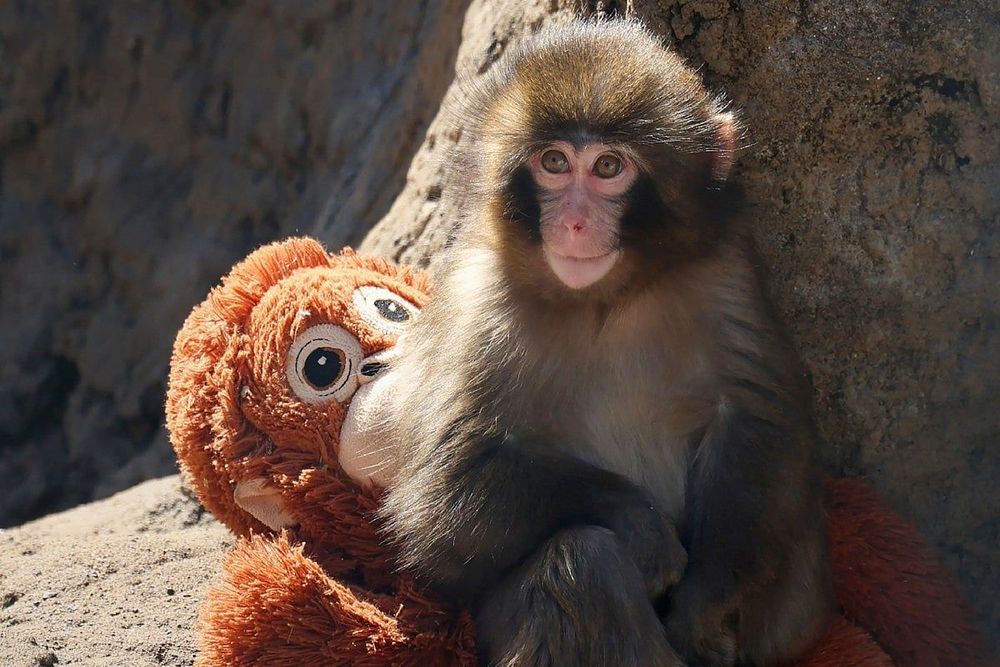
Japan's monkey sensation Punch gets thousands of birthday messages as he turns 1 on Sunday
Punch, the abandoned baby monkey whose image clinging to a stuffed orangutan touched millions worldwide, is celebrating his first birthday on Sunday with an outpouring of affection from fans across the globe who have sent 2,500 birthday cards and messages to his home at Ichikawa City Zoological and Botanical Garden.
The young Japanese macaque, also known as a snow monkey—the most northern-living non-human primate species endemic to Japan—was rejected by his mother shortly after birth a year ago, likely due to the extreme heat that marked his arrival into the world. Zookeepers at the facility in Ichikawa, Chiba Prefecture, just east of Tokyo, stepped in to nurse the fragile infant and provided him with a plush toy to help develop the gripping ability critical for newborn macaques' survival.
Today, Punch has outgrown his pudgy baby appearance and the need for his beloved plushie. He now mingles and plays among approximately 50 other monkeys in the enclosure at the zoo, which was established in 1987 and spans roughly 60,000 square meters housing about 40 species and 300 animals.
From Viral Sensation to Zoo Favorite
Despite blending in with his troop, Punch continues to draw substantial crowds. Birthday cards and messages from admirers in Japan and beyond now cover the walls of a special indoor exhibit chronicling his journey from those earliest vulnerable days to his current thriving state. Video footage displayed at the exhibit captures the full arc of his remarkable first year.
"As Punch was trying very hard struggling to live each day, his two keepers did everything they can while other staff watched over him," recalled Takashi Yasunaga, head of the zoo. "It was extremely hot when Punch was born. The memory is still clear to me as the hot season returns."
After six months of intensive care, Punch was introduced to the monkey enclosure on January 19, 2026, to join the established troop. The stuffed toy approach used by his keepers reflects a recognized practice in wildlife rehabilitation centers globally, where orphaned primates are given soft toys as surrogate mothers to provide comfort and reduce stress.
When zoo staff posted images of Punch with his toy on social media the following month, the response was immediate and overwhelming. Videos of the young macaque racked up more than 40 million views across social media platforms in February alone, transforming the seven-month-old into an overnight internet celebrity.
A Story of Perseverance
The initial integration proved challenging for Punch, who faced the complex social dynamics of Japanese macaque society. These primates live in matrilineal groups organized around dominant female lineages, where females remain in their natal groups for life while males eventually leave before reaching sexual maturity. When other monkeys initially rejected the newcomer, Punch would rush back to his orangutan toy for comfort, prompting fans to rally behind him with the hashtag #HangInTherePunch.
It was not merely Punch's cuteness that resonated with viewers, but his solitary struggle for acceptance that struck an emotional chord with people around the world.
Kumi Ishizawa, a Kobe resident visiting the birthday exhibit, discovered Punch on social media earlier this year while battling illness.
"He moved me ... I kept on telling myself that I'm going to get well and come visit to see Punch," said Ishizawa, who has since recovered. "And here I am, I made it. I'm very happy I could finally see him in person."
Yeye Lights, a longtime city resident who had never visited the zoo before becoming a Punch fan, now holds an annual visitor pass. Her daughter in the Philippines first told her about the monkey.
"I have a cake for Punch-kun, I'm celebrating with my friends,"Lights said, using an affectionate Japanese honorific. She expressed gratitude to the monkey's two primary carers for their dedication.
According to Yasunaga, the zoo welcomed tens of thousands of additional visitors following Punch's rise to fame, with roughly half traveling from overseas to see the young macaque. As Punch celebrates his first birthday and settles into life among his troop, he faces many years ahead—Japanese macaques can live 28 to 32 years in the wild and may exceed 30 years in captivity, with some individuals reaching nearly 40 years of age.