Al Owais Foundation honors 'Samson of Arabia' and filmmaker at Dubai premiere
Ali bin Hassan, the strongman known as "Samson of Arabia," and director Nasser Al Dhaheri received commemorative shields at the Dubai premiere of a documentary about Hassan's life. The Sultan Bin Ali Al Owais Cultural Foundation hosted the red-carpet screening on October 31, 2026, at VOX Cinemas in Wafi City.
 Nadia El-Sayed
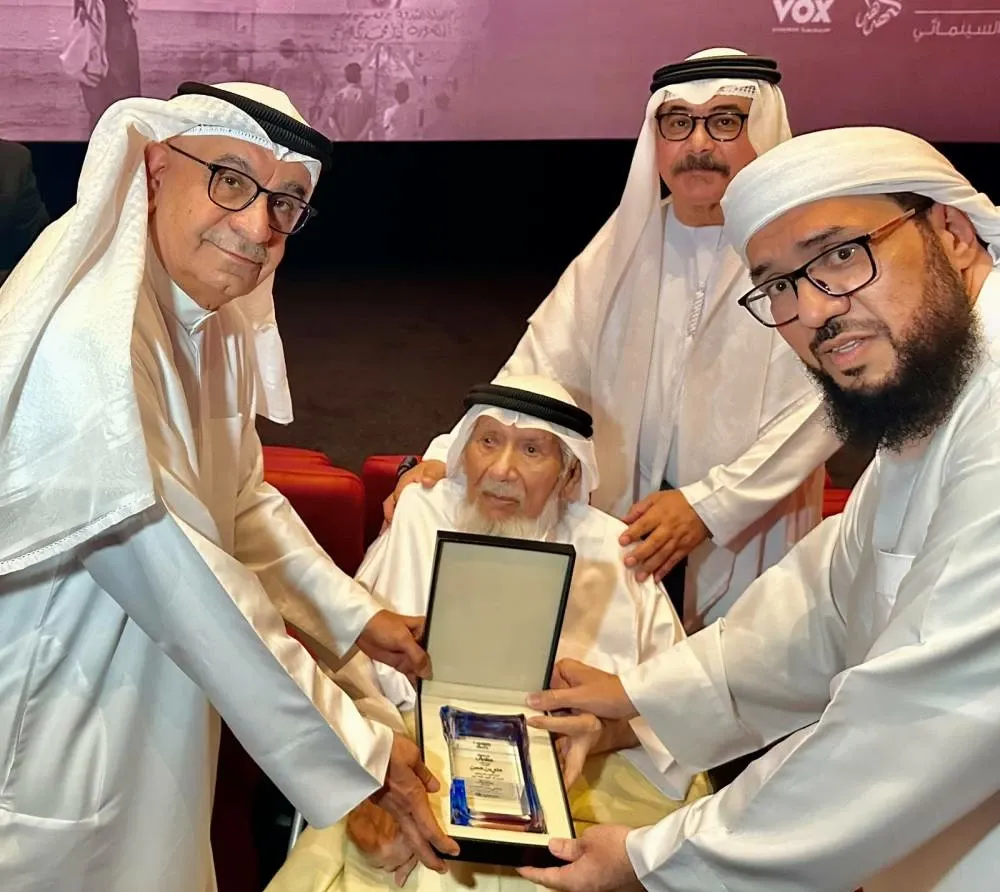
Recognition for the performer and the filmmaker
The documentary, "Samson of Arabia: The Story of a Hero from the UAE," was presented through the Al Owais Film Club. Before the Saturday evening screening, foundation Secretary-General Abdul Hamid Ahmad presented both men with the Al Owais commemorative shield. The honors recognized Hassan's performances, which brought the UAE's name to audiences across the region in the 1960s and 1970s, and Al Dhaheri's work recording his story.
Among those attending were Mohammed Ahmed Al Murr, chairman of the Mohammed Bin Rashid Library Foundation, and Dr. Fatma Al Sayegh, a member of the Al Owais foundation's board of trustees. The audience also included filmmakers, media professionals, intellectuals and people interested in Emirati heritage.
Hassan received an enthusiastic welcome, with many guests seeking photographs with him. His long hair, thick beard and familiar smile remain recognizable features. The foundation also describes his signature performance costume: a leopard-skin-style outfit with leather belts and bands around his waist and wrists.
Al Dhaheri described Hassan as now over 80 and living alone after bidding farewell to Delilah. In a separate account, the foundation reported that Hassan, then 80, had lost his sight but retained his memory fully.
The feats and the name
Completed in 2025, the 85-minute documentary revisits performances in which Hassan broke rocks, let cars roll over his hands and pulled vehicles with his hair. His other feats included lifting weights and a donkey with his teeth, as well as lying on glass.
The film also traces the origins of his name. King Hussein bin Talal gave him the title "Samson of Arabia," while President Gamal Abdel Nasser named him "Samson the Mighty." Hassan chose the former. According to the Al Owais Cultural Foundation, the late Sheikh Rashid bin Saeed Al Maktoum, then ruler of Dubai, ordered that it become his official name on his national identity card and passport.
Al Dhaheri said Hassan traveled between Arab cities, earning only a few dirhams from performances while announcing the names of the UAE and Dubai onstage. The director described him as "a popular ambassador before the age of ambassadors."
The story extends to Hassan's sons. Al Dhaheri said he learned during his research that they had followed their father into feats of strength and set a Guinness World Record by pulling an aircraft. Footage of that achievement appears in the documentary.
Rebuilding a scattered archive
Al Dhaheri spent nearly two years making the film, combining field research with interviews with people who had seen Hassan perform. He assembled rare photographs and issues of Arab magazines that had featured the strongman on their covers.
Much of the original material was no longer available. The director said a fire at Hassan's first house had destroyed most of his personal archive. He sought documents from archives in several Arab countries, including Egypt and Lebanon, and arranged for some items to be restored. Surviving newspaper clippings, magazine cuttings and used performance tickets were collected and digitized for the production.
For Al Dhaheri, the central challenge was how to film a story that he and other children had heard in Al Ain, Abu Dhabi and Dubai: accounts of a man breaking rocks on his stomach and pulling cars with his hair. He said he wanted to convey the legend without turning it into fantasy, while bringing the person behind the feats into view.
The documentary has appeared at several international festivals. It screened at the I-Film Festival in Abu Dhabi during a weekend in April 2026, when Al Dhaheri also received an honorary award for his contributions to global cinema.
Preserving stories through cinema
Ahmad placed the premiere within the foundation's broader support for Emirati documentary filmmaking. He said Hassan's story had circulated orally for 50 years and argued that preserving it on film was a cultural responsibility. Cinema, in the foundation's view, provides a visual record of national memory.
That approach includes documenting oral histories and popular narratives for a lasting visual archive. Ahmad said the foundation had revived its Film Club to bring filmmakers and audiences together through screenings and discussions of Emirati, Arab and international films. He said the club's next phase would offer a broader and more varied program.
The awards also acknowledged the generation of performers who entertained audiences when resources were limited, Ahmad said, alongside Al Dhaheri's work giving Hassan's story a cinematic and human dimension.
Al Dhaheri's biographical films
An Emirati writer, producer and director, Al Dhaheri spent 20 years as a daily columnist for the UAE newspaper Al-Ittihad and has published 14 books, according to the Abu Dhabi Arabic Language Centre. His feature-length documentary "On the Life of Water… Palm Trees… and People" won 21 international awards.
Al Dhaheri identifies "Samson of Arabia" as his second biographical film. His first, "The Millstone," explored the life of the late Sheikh Zayed bin Sultan Al Nahyan.
He is preparing another film, "On the Bank of a Homeland," about Dr. Faleh Hanzal. A former royal guard member in monarchical Iraq, Hanzal later moved to Jordan and then, in the 1960s, to Abu Dhabi. He worked drilling water, gas and oil wells before becoming the first historian of the UAE's history, culture and social life.