From consumers to creators: The Middle East's anime and manga revolution
At MEFCC 2026 in Abu Dhabi, industry leaders from Crunchyroll, Boss Logic and Sandstorm Comics reveal how the Middle East is transforming from a region that imports anime and manga into one that produces original content.
 Nadia El-Sayed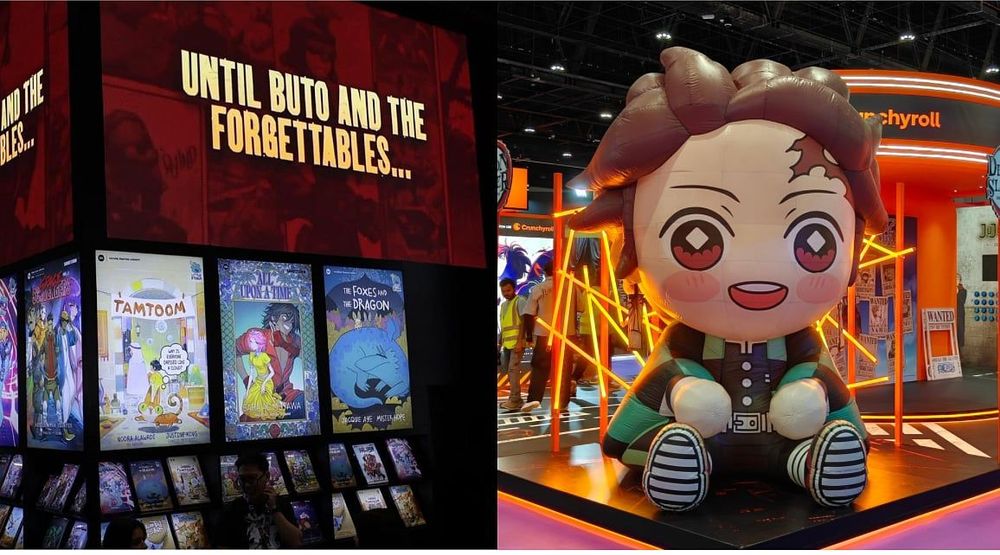
A market that was always there
For generations, anime in the Middle East meant watching content made elsewhere. That dynamic is shifting. At this year's Middle East Film and Comic Con in Abu Dhabi, which drew over 46,000 visitors and featured more than 500 brands, three voices from different corners of the industry pointed toward the same evolution: a region moving from consumption to creation.
Akshat Sahu, VP of APAC and MENA at Crunchyroll, Kode Abdo (known online as Boss Logic), and Mo Abedin, editor-in-chief of Sandstorm Comics, shared their perspectives on how the Middle East's relationship with Japanese and Western pop culture is entering a new phase.
When asked how new the region's anime audience actually is, Sahu challenged the assumption that this is a recent phenomenon. Anime has been broadcast in the Middle East since the 1970s, he explained, and an entire generation grew up watching it. What has changed is not the audience's existence but its visibility and engagement.
Younger viewers today are living the lifestyle more openly, turning what used to be casual Saturday-morning viewing into something closer to an identity. Streaming has played a significant role in that transformation. Where broadcast anime once meant appointment viewing with no second chances, platforms like Crunchyroll made the format accessible on demand.
Crunchyroll, which reached 21 million paid subscribers globally in early 2026, currently offers nearly 1,350 shows in its library. The platform has produced 40 Arabic-dubbed titles so far and aims to expand to the top 100 shows. Sahu reported that Arabic dubs have seen a threefold increase in viewership over the past six months, driven by modern standard Arabic dubbing that reaches audiences across the region.
The global anime market, valued at approximately $35 billion in 2026, is projected to reach between $48 billion and $67 billion by 2030-2032. Industry reports identify the Middle East as the fastest growing region for anime consumption, even as Asia-Pacific remains the largest market overall. The Association of Japanese Animations reported that the total anime market value hit a record 3.84 trillion yen for the 2024 fiscal year, with international earnings exceeding domestic revenue for the first time.
The piracy problem and the streaming solution
Sahu addressed the piracy issue directly. Fans turn to piracy when they lack a clear, convenient and affordable option, he said. His view is that legitimate access, when done well, wins people over without the need for enforcement. Someone who experiences Crunchyroll likes the experience and does not go back to piracy, he argued.
He pointed to Demon Slayer's theatrical run as a case study. Viewers who did not typically watch anime attended the film with friends and subsequently got hooked, a pattern that showed up clearly in the platform's streaming data once the film became available online.
From fan art to Hollywood
Kode Abdo represents a different side of anime and pop culture's feedback loop. Originally from Syria and now based in Melbourne, Abdo built a career creating fan casting art before that work began shaping the industry it was imagining.
A lot of creative rooms would display fan art pictures I made that inspired the outcomes of series,
he said, citing Star Wars, Black Adam and The Witcher as productions where his work fed directly into casting conversations.
The Russo Brothers contacted him via email after seeing his mockup posters for The Avengers, eventually commissioning him to create official artwork for Avengers: Endgame. This marked his transition from online fan artist to official studio collaborator. For years, that influence came with a condition: anonymity. At the earlier stage of my career, I never showed my face. I wore a mask,
he said. The decision to step into view, once studios wanted to work with him directly, was more unsettling than exciting. I was hesitant. Even though it was a surreal, amazing moment, it was actually a fearful moment because I didn't want to show myself.
The AI question and artistic identity
Asked about artificial intelligence's growing presence in digital art, Abdo drew a sharp distinction.
If you're starting to use it as, it's creating your whole artworks and it's creating your whole personality, are you even the artist anymore? That's the line you have to draw,
he said, framing the question as one of authorship rather than tool use.
His defence against being replaced by AI is consistency of voice.
I try to infuse my style to whatever genre I pick, even if it's gaming, music, sports, comics or movies, because that's what AI can't do,
he explained.
Building original IP from the Middle East
Abdo's next move reflects the same shift that Sahu and Abedin both described: a region moving from consuming intellectual property to producing it. He is exploring setting up a Boss Logic studio in the UAE, with plans to launch original IP from the region rather than about it.
Imagine the whole MCU, Marvel universe. That's what my IP will be, but coming from the Middle East,
he said.
The choice of location is not incidental.
I'm from Syria originally, and UAE is the hub of entertainment, but it's still the Middle East. I still find it close to home. If I can elevate the people from here, that's a win for me.
Sandstorm Comics and the Emirati voice
That same instinct, building something recognisably local without imitating what already exists elsewhere, sits at the centre of how Mo Abedin runs Sandstorm Comics, the Abu Dhabi-based publisher behind titles like Solarblader.
Asked whether Sandstorm feels pulled between readers raised on Marvel, DC and manga and international buyers looking for something distinctly Emirati, Abedin rejected the premise.
The story always comes first. I don't think something has to look traditionally Emirati to feel Emirati,
he said. That comes through in the setting, the characters, the way people speak, and the small details and experiences that come from actually living here.
Solarblader, Sandstorm's best-selling title, makes the case directly. Set in Abu Dhabi five hundred years in the future, the series imagines a world powered by XON, or Liquid Sunshine, a concentrated liquid form of solar energy. The premise traces directly back to the UAE's renewable energy ambitions. Visually, it's science fiction, but the idea behind that world came from what we're already doing in the UAE around renewable energy and sustainability,
Abedin said. That's what makes it ours.
International readers respond well to that unfamiliarity, he added. They're seeing something they haven't seen before.
The manga format wins
Sandstorm publishes both American-format comics and manga-style graphic novels. Sales numbers have settled an argument Abedin did not expect to have this early.
When we looked at our own sales, our manga books were outperforming our American-format comic books, which was really interesting to us,
he said.
This year's MEFCC reinforced that pattern. Smaller, manga-sized editions of Sandstorm titles, introduced alongside the standard larger format for the first time, drew a strong response from attendees. The global comic book market was valued at approximately $18 billion in 2025 and is projected to reach $24 billion by 2031, with Asia Pacific representing an estimated 59.6% of global revenue.
Abedin is careful not to frame that appetite as imitation. Asked how he distinguishes a submission that genuinely uses manga's visual language from one simply copying it, he said the tell is not stylistic. You can usually tell quite quickly whether someone has a story they genuinely want to tell or whether they simply like the look of a particular manga or anime,
he said. The important thing for us is what's underneath the art style. Who are these characters? What's the story? Why does this world exist?
That standard applies regardless of who is submitting.
We're not trying to create Japanese manga in the UAE. We're seeing what happens when creators from here take that influence and make something of their own.
Sandstorm plans to work with between 10 to 17 books per year and has committed to developing weekly workshops facilitated by approximately five art directors to support local talent development.
The seven-year-old author
Nowhere does that philosophy show up more clearly than in Sandstorm's youngest published author. Sultan AlWahshi was seven when his story, about a child pulled through a black hole into the year 3045, was approved through the publisher's open submissions process, with no special programme or age category involved.
He submitted a story and we liked it,
Abedin said. Sultan worked alongside Greg Baldwin of Lost Bear Studios, whose credits include Ratchet & Clank, to develop the book, now published under Sandstorm's children's imprint, Little Storm. Abedin described the editorial approach in the same terms he would use for any adult creator. Whether you're seven or twenty-seven, the principle is the same. If there's something genuine there, we want to help bring the best version of it out.
What has changed since Sandstorm started
Asked to reflect on how far the industry has come since Sandstorm launched, Abedin pointed to the disappearance of a gap that used to define the region entirely.
There wasn't really an established comics industry in the UAE. There wasn't a large pool of writers, artists or editors with experience making comics professionally, and there wasn't a clear path for someone here who wanted to enter the industry,
he said.
That is no longer true in the way it once was. Submissions have grown, workshops and camps are running regularly, and Sandstorm is heading into its third year exhibiting at New York Comic Con. North American consumer sales of comics and graphic novels reached approximately $1.94 billion in 2024, up 4.0% from 2023 and 73% above 2019 levels, demonstrating the sustained strength of the market Sandstorm is entering.
People come to the booth already knowing Sandstorm and looking for specific titles,
Abedin said. That's a massive difference from where we started.
His stated ambition for what comes next stays close to the reason he started in the first place. When I was growing up here, if you told someone you wanted to write comics or become a comic artist, there wasn't really a path for you,
he said. I want a kid growing up in the UAE today to know that there is one.
From import to origin
MEFCC itself reflects that evolution. The event began in 2012 in Dubai at the Dubai International Marine Club with approximately 8,000 attendees. By 2015, it had grown to more than 25,000 attendees with Stan Lee appearing among more than 20 celebrity guests. The 2026 edition's record-breaking attendance of over 46,000 visitors demonstrates how far the region's pop culture engagement has come.
Between a streaming platform racing to meet a decades-old fandom, an artist whose fan work reshaped Hollywood casting decisions before he had even shown his face, and a publisher proving that a story can be Emirati without looking like anything that has come before it, the picture that emerges is not of a region discovering anime and manga for the first time. It is one that has had the audience all along and is now building the infrastructure to match it.