What to expect from UAE weather through Wednesday
Temperatures are forecast to dip slightly across the UAE on Sunday, with partly cloudy conditions and fog or mist possible overnight. Heat will remain intense in desert areas, with Liwa reaching 47°C.
 Omar Al Nuaimi
Sunday forecast and fog conditions
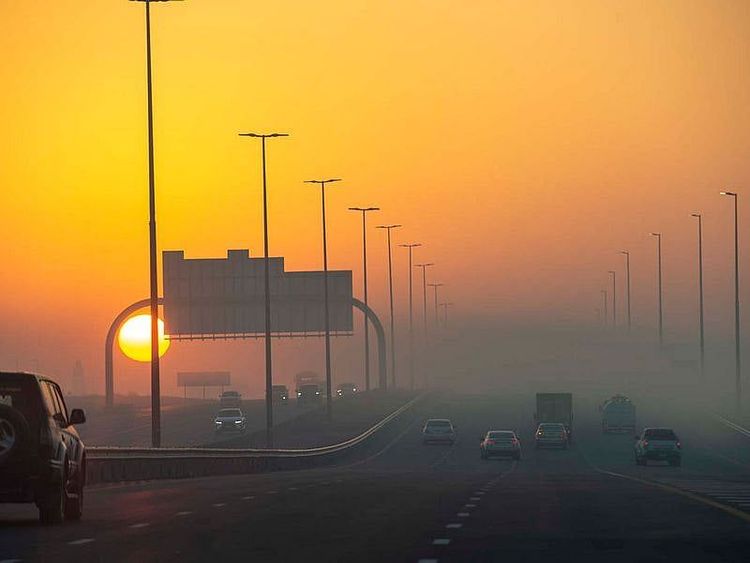
Temperatures are expected to ease slightly across the UAE on Sunday, with partly cloudy conditions and a chance of fog or mist overnight into Monday morning, according to the National Center of Meteorology. The NCM, established in 2007 and responsible for weather forecasting and issuing early warnings across the Emirates, said clouds would develop over eastern areas during the day.
Humidity will increase during the night and into Monday morning across some coastal and inland areas, creating conditions for fog or mist formation. This phenomenon occurs when the desert floor rapidly loses heat overnight while humidity remains high from daytime sea breezes, a process known as radiation fog that accounts for around 95 percent of all fog recorded in the UAE.
Research from Khalifa University's Environmental and Geophysical Sciences Lab has identified the Sweihan desert and areas southwest of Abu Dhabi as two of the country's primary fog formation zones, where open desert surfaces lose heat particularly quickly overnight. Motorists should note that Abu Dhabi Police reduces the maximum speed limit to 80 km/h on roads during foggy conditions, and drivers can face fines of Dh500 and four black points for using hazard lights while driving in fog.
Sunday temperature details
Despite the slight temperature decline, conditions will remain hot across much of the country. Liwa, the southernmost settlement of the UAE located at the edge of the Rub' al Khali desert near the border with Saudi Arabia, is forecast to reach 47°C on Sunday. The oasis, which consists of approximately 50 villages stretching about 100 km east to west, regularly experiences some of the highest temperatures in the Emirates. Al Ain is expected to record a high of 45°C, while Abu Dhabi, Sharjah and Ajman will reach 43°C. Dubai will see temperatures of 42°C, and Fujairah is forecast to be considerably cooler at 35°C.
The temperature easing comes as September marks the final month of summer in the UAE, with astronomical autumn set to begin on September 23 when the sun is directly above the equator before its apparent movement south. Humidity could reach 90 per cent in Abu Dhabi and 85 per cent in Dubai, Fujairah, Liwa and several western and island areas.
Winds will be light to moderate from the southeast to northeast, blowing at 10 to 25 km/h and strengthening at times to reach up to 40 km/h. Conditions in both the Arabian Gulf and the Sea of Oman are expected to remain slight throughout Sunday.
Monday and Tuesday outlook
Little change is expected on Monday, with fair to partly cloudy skies and clouds continuing to appear over eastern parts of the country. Humidity will again increase overnight and into Tuesday morning over some coastal and inland areas, bringing another chance of fog or mist. Long-term records show an average of just under 24 fog days per year at Abu Dhabi International Airport, with annual fog days ranging from eight to 51. Winds could reach 35 km/h at times.
A change in cloud activity is expected on Tuesday, when clouds are forecast to develop across eastern and southern areas and could become convective. These clouds form when warm humid air rises through cooler surrounding air in the atmosphere, and as moisture builds up they can become rain-bearing clouds that may lead to thunderstorms. Humid conditions will continue overnight, with fog or mist possible over some coastal and inland areas on Wednesday morning. Southeasterly winds are expected to turn northwesterly, reaching up to 35 km/h.
Wednesday conditions
By Wednesday, conditions are forecast to remain fair to partly cloudy, with clouds developing over eastern and southern areas during the afternoon. Winds will shift from southwesterly to northwesterly and could reach 30 km/h. The sea is expected to remain slight in both the Arabian Gulf and the Sea of Oman throughout the period.